
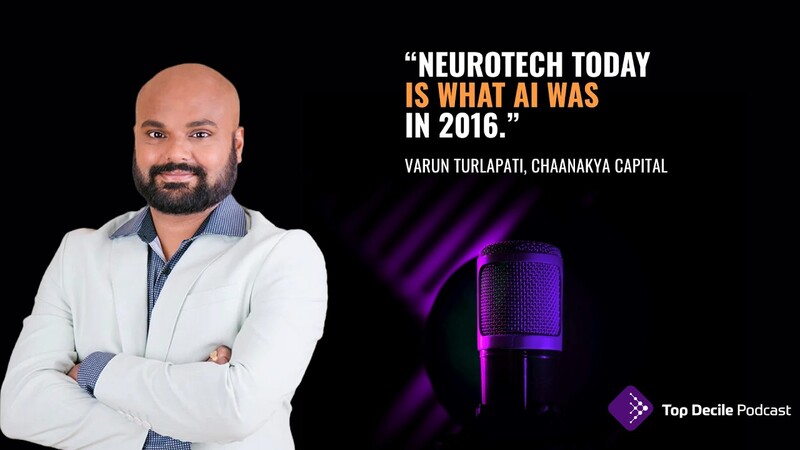
Every year, startups working on Parkinson's, chronic pain, and brain computer interfaces struggle to raise, "not because the science is bad, but because investors can't read the papers." That's how host Connor Sattely of Decile Group's Deals Team opened this episode of the Top Decile Podcast, and it's the problem his guest decided to fix.
Watch The Full Episode Here:
Varun Turlapati spent 16 years as a software engineer, watching science-heavy startups in neurotech, medtech, and chronic pain get passed over by VCs who lacked the technical depth to evaluate them. With a master's degree in electrical and computer engineering, he realized his technical edge could become a fund thesis. He founded Chaanakya Capital, a pre-seed fund backing US neurotech and neuro-focused medtech startups at the earliest stages, and he's convinced the sector is standing exactly where AI stood a decade ago.
Neurotech Is Bigger Than the Brain
Ask most people to define neurotech and they'll reach for brain implants. Varun starts somewhere else entirely. Brain computer interfaces, he says, are "the glamorous part of neurotech that often does the rounds." The real scope is the body's entire command and control system, the network of nerves and neurons that signals everything from hunger to pain to a failing heart valve.
"So it doesn't even have to be brain disease disorder. It can be something like irritable bowel syndrome," he explains. Spinal cord stimulation, peripheral nerve stimulation, bioelectronics that calm an overfiring nerve before it damages the heart: all of it falls inside the thesis. When technology is used to "treat, maintain, manage, repair any of this, that's NeuroTech for us."
What strikes him most is how little we still know. We arguably understand more about the deep ocean and deep space than about what sits between our ears. "This is 2026, not 1826," he says. For Varun, that gap isn't a deterrent. It's the opportunity.
Why Neurotech Is Where AI Was in 2016
The core of Varun's pitch is a timing argument. Think back to how AI was discussed in 2016: a research curiosity, something you wouldn't rely on, a technology perpetually decades away. "People would often think AI equals 2050," he recalls, "not 2022, which is when things completely got disrupted." He remembers startup meetups full of "very research kind of murmuring" that, within a few years, gave way to a world where "there's not a pitch that I've heard now which does not have AI in it."
"Neurotech for us is that now," he says. "There has been enough critical mass of research that is done." The science moves slower than software, he concedes, but the inflection point looks the same. His prediction is blunt: "Five years down the line, everything would be neurotech." Digestive disorders, inflammation, cardiovascular health, pain, prosthetics, all of it touched by the same underlying technology. "It is a good time."
The Edge of a Focused Fund
So why back an emerging investor instead of trusting a billion-dollar platform fund to spin out a few neurotech deals? Varun's answer starts with a pattern he's seen from inside the industry: the giants of medtech, names like Abbott, Boston Scientific, and Medtronic, "still keep a close ear to the ground for what innovation is coming out of startups," then acquire what works. Early stage innovation is a market the big players deliberately wait out.
That's where Chaanakya lives. "We are laser focused," he says. Exciting companies get pitched to the fund from cancer and biotech, spaces where the team feels genuinely competent, and they still pass. "We're not distracting ourselves with anything else that comes up." The remaining bandwidth goes into working with founders, enabling partnerships, and plugging into university tech transfer programs. The strategy, in his words, is simple: "Go buy low and sell high." Enter early enough, at reasonable valuations, and even a modest exit can produce a strong outcome.
Four Investments in Ten Months
Chaanakya Capital made four portfolio investments in a span of ten months since launch, momentum Varun credits in part to VC Lab and the infrastructure it set up around the fund. One portfolio company sits at the intersection of brain computer interfaces, neuroprosthetics, and industrial robotics. "Imagine a bionic hand that fits an amputee and the amputee can use it as dexterously as their own hand," he says. Unscrew that same hand, mount it on a robotic arm, and a robot can perform dexterous work in hazardous environments no human should enter.
Another investment tackles hydrocephalus, a condition that's fatal for a small share of patients and can turn deadly within hours. The company adds a smart sensor to the existing standard of care, a device embedded in the skull that monitors pressure and releases only the fluid that needs to be released. When a neurosurgeon, now an advisor to the fund, reviewed the device, his verdict was: "They just need to make it a little smaller and they should be good." Varun's reaction: "exit coming up."
Advice for the Next Wave of Fund Founders
Varun's path hasn't been free of skeptics, and his advice for aspiring VCs starts there. "The way I have done this is to not sit in the corner and cry when I've been told that I cannot do it," he says. He's been approached by two women with PhDs in the life sciences who were told they weren't ready to start a fund. His response: "If you've done a PhD in your field, don't let anybody talk down to you." There are people with no degree at all writing million-dollar checks.
The real test, he argues, is internal. If your mind drifts to fallback mechanisms and worst-case scenarios, that's a warning sign. But if criticism triggers indignation and a drive to solve the problem, "that's a sure shot signal" you'll stick through it. "You have to have that passion." From there, the playbook mirrors what any VC would tell a founder: start small, iterate, and keep finding ways to make it happen. "There are ways to make it happen," he says. It's how he built Chaanakya, and it's how he plans to keep building.
Learn more about the fund and request access on Decile Access: https://decileaccess.com/funds/chaanakya-capital
About Chaanakya Capital
Chaanakya Capital is an early stage venture capital firm investing in US neurotech and neuro-focused medtech startups, with an emphasis on device companies rather than pharmaceutical solutions. The fund backs companies from pre-seed through early rounds, entering at reasonable valuations and supporting founders through partnerships, ecosystem connections, and university tech transfer programs. Founder and Investment Lead Varun Turlapati brings 16 years of software engineering experience and a master's degree in electrical and computer engineering to a thesis built on deep technical diligence in one of the most underexplored frontiers in human health.
Watch The Full Episode Here: https://www.youtube.com/watch?v=Cb1PWkvg1bI