
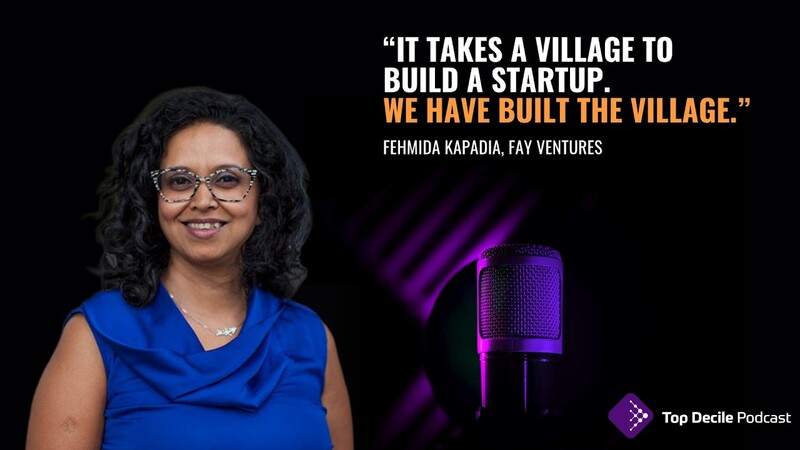
Most venture capital flows to software, where products ship in weeks and risk can be iterated away. Fehmida Kapadia works in the opposite corner of the market. "Allow me to blow your mind, Connor," she told host Connor Sattely on the Top Decile Podcast. "Of the 2200 VC firms that are currently existing, I would say in the US, only 3% invest in MedTech." That scarcity isn't a reason to stay away, she argues. It's the opportunity. Kapadia, Founder and Investment Lead of Fay Ventures, spent two decades advising more than 150 MedTech startups before ever raising a fund, and she built an 800-plus member network of founders, clinicians, and academics along the way. Now she's putting both to work on one of the hardest problems in healthcare investing: the funding gap between a working prototype and FDA clearance.
Watch The Full Episode Here:
The Gap Where MedTech Startups Get Stranded
MedTech companies, Kapadia explains, often begin life inside universities, either as licensed IP or as student-led startups with deep technical expertise. The early miles are manageable. "The first initial part of the development works well because they bank on support from the university, they can get funding from non-dilutive funding sources like the SBIR grants," she says. Then the road runs out. "The moment they get to this threshold where they need to start the studies, right, to get through to the FDA approval, those funding sources that they were depending on initially are not relevant anymore. They need to raise dilutive money and they're too early and not fully de-risked."
Too risky for traditional VCs, too far along for grants. That's the middle where founders stall, and it's exactly where Fay Ventures writes its checks. The fund backs US AI-enabled MedTech founders at the seed stage, with support designed to carry them across the regulatory bridge, not just fund the attempt.
Building the Village Before the Fund
What makes Fay Ventures unusual isn't just its focus. It's the order of operations. Kapadia built Amplify MedTech, her 800-plus person ecosystem, years before she started investing, because she saw founders who needed far more than capital. "That is the stage where startups need a lot of help and support that goes way beyond the check," she says. The network now sources much of her deal flow and gives portfolio companies access to the specialists a MedTech company can't succeed without. "Our startups can leverage that ecosystem to find the mentors, the advisors, the experts, the clinicians, the academics that they need to partner with. Because we all know that you don't build a startup alone. It takes a village, and we've built the village with Amplify."
That same relationship muscle powers her fundraise. Her LPs come almost entirely from the MedTech world: corporate veterans, doctors, and longtime startup advisors who understand the gap she's filling and want in early. "Everything that we do in this world is about the relationships that we build at the end of the day," she says. "Amplify MedTech is all about relations and my LP network is all about relations as well."
How She De-Risks the Riskiest Stage
Investing before FDA clearance means Kapadia has to find her own signals, and she's specific about what they are. First comes product market fit, defined more strictly than most founders define it. "They might have done their customer discovery, they might have had their 500 interviews and they know there is an unmet need, but they never ask the question, would you pay for this? If we build it, would you buy it?" Skip that question, she warns, and the consequences compound: "You're gonna spend two years and a few million dollars, and then you get FDA approval for an indication that is not ready for your product."
Second is the product itself, which has to matter. "We're not going into Me Too products, we are not going into incremental technologies, we want technologies that are really transforming healthcare." And third is the team. She actively wants to back first-time founders, but she screens hard for character: "Are you coachable? Are you willing to pivot when it is required? Do you have the long-term vision for this?"
Why AI-Enabled MedTech, and Why Now
Fay Ventures' thesis is deliberately pointed at where the industry is going, not where it's been. MedTech used to mean hardware: implants, surgical tools, niche devices. Today, Kapadia estimates, "80 to 90% of MedTech companies today have a hardware and a software element associated with it," and that software throws off data that can transform care. Founders who ignore it "are missing the boat," she says. The ones she backs are using it for early diagnosis, personalized treatment, clinical decision support, and patient monitoring. "This field is exploding and it's going to change how we do healthcare in the next five to ten years."
She's also clear-eyed about where a smaller fund fits in the food chain. Asked how a nimble seed fund navigates a market associated with billion-dollar firms, her answer doubles as a pitch to founders: "We are funding those that Sequoia is not ready to fund yet. We are getting them ready to go get funding from Sequoia."
Betting on Perseverance
The signal Kapadia keeps returning to is founder motivation, often rooted in lived experience. She describes one founder her fund is actively evaluating who is building an oculomics company for early detection of neurological and retinal diseases, and who was herself diagnosed with a neurological disease. "What lived experience gives you is perseverance," Kapadia says. "That is really what differentiates a founder who is passionate about their technology versus a founder who's building a startup because that's the next cool thing to do. Because startups are hard. They are very hard."
It's a standard she meets herself. As Sattely observed at the close of the episode, her own lived experience is watching founders fall into the clearance gap, and Fay Ventures is the solution she built in response.
Learn more about the fund and request access on Decile Access: https://decileaccess.com/funds/Fay-Ventures
About Fay Ventures
Fay Ventures is a seed-stage venture fund backing US AI-enabled MedTech founders in the gap between working prototype and FDA clearance, pairing capital with hands-on advisory and the Amplify MedTech ecosystem of 800-plus founders, clinicians, and academics. The fund is led by Fehmida Kapadia, Founder and Investment Lead, a PhD biochemist and MedTech ecosystem builder with decades of experience who has advised more than 150 MedTech startups.
Watch The Full Episode Here: https://www.youtube.com/watch?v=hsR7YHp9aZI