
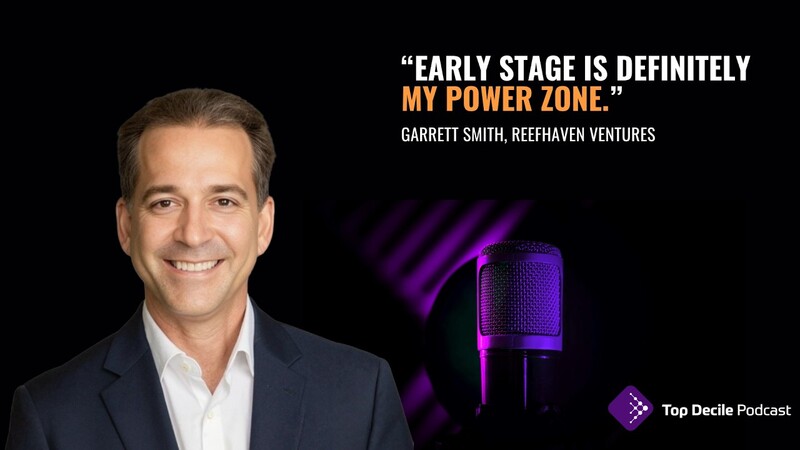
Garrett Smith has already exited two medtech startups for a combined $600 million. He could be on a beach right now. Instead he built ReefHaven Ventures, an early-stage fund writing checks into life science and medtech founders working at the exact convergence of biology, robotics, and AI.
Watch The Full Episode Here:
Why Biology, Robotics, and AI Together
Smith holds a PhD in bioengineering from UC San Diego and spent years inside Johnson & Johnson investing in and partnering with early-stage companies before going out on his own. That path gave him a lens most generalist funds don't have: he has sat on both sides of the table, as a founder building the technology and as a corporate investor evaluating it.
Ask him why ReefHaven backs the intersection of three categories instead of picking one, and he doesn't hesitate. "We're seeing this kind of merger between drugs and also devices," Smith says. "There's a lot of surgeries now where there's intuitive surgical, they do robotic surgeries. We're seeing more and more merger between AI, robotics and med tech. So it's really an exciting place to be, and also a huge part of our thesis."
The Doctor Stays in the Loop
Every automation story runs into the same fear: what happens when the machine is wrong. Smith's answer is that ReefHaven backs tools that assist physicians, not tools that replace their judgment. "With these AI surgical tools, it's still in the hands of the doctor, at least for now," he says, pointing to a portfolio company building robotically guided trachea tube placement. "Before people are accepting the fully automated, just like the fully automated car, they need to see that the surgeon or the doctor is still in control of the tool."
That framing shapes diligence. Smith looks for founders who understand both the technical build and the regulatory reality. "We see some founders that are all on just the tech side, and that could be concerning because they don't understand all the hurdles and regulatory that we've had to deal with in building med tech companies," he says. "And then if you go to the other side, you don't have somebody with the robotics or the AI experience. They're not going to be able to build the tool effectively. So you have to find that sweet spot."
Two Deals In, Three Months In
ReefHaven made its first two investments within three months of launching. The first is a system that repositions imaging equipment during surgery so surgeons get better precision, cutting operating room time by roughly 20 minutes per procedure. ReefHaven co-invested alongside a strategic partner at the seed stage, a structure Smith says is rare to line up this early. The second is a cancer diagnostic tool that tells physicians what type of cancer a patient has almost immediately, instead of the multi-week wait that normally delays treatment. "It's literally life saving and improving treatment outcomes," Smith says.
An LP Base That Looks Like the Thesis
ReefHaven's early backers read like a proof point for the strategy. One is a serial medtech entrepreneur Smith describes as "the Elon Musk of MedTech in many ways," who has built and sold four startups from inception through IPO and acquisition. A corporate venture fund has also committed capital, which Smith notes is unusual traction for a Fund I. A multi-billion dollar philanthropic organization has committed as well, drawn by ReefHaven's roots in the San Diego biotech ecosystem around UC San Diego. "They see that not only are we founder operators, but we're also really deeply embedded in the ecosystem," Smith says.
Why San Diego
Smith has worked in both the Bay Area and San Diego, and he's specific about what makes the latter different: deep research talent from UC San Diego and other institutions, without the same dense layer of VCs and repeat entrepreneurs the Bay Area has built over decades. "There's even more of a need for seed capital and also operational support that we can provide with ReefHaven in San Diego," he says. "It's really the sweet spot for what we do."
What's Next for ReefHaven
Smith expects to keep funding one to two companies per quarter, looking for founders solving real unmet clinical needs with something genuinely different from what's on the market. "Our North Star is really finding the right companies that are going to change patient care and really impact and improve patient life," he says. His advice to managers earlier in the journey echoes what he credits for his own progress: "You have to be fully in it. It's almost like a startup in many ways where you have to be all in." He also points to the value of going through VC Lab: "It's important to have people that support you that have gone through it before that can advise you."
For LPs and Founders
Smith wants to hear from founders building at the convergence of biology, robotics, and AI, from family offices and investors evaluating new funds, and from VCs open to syndicating deals. For LPs who want exposure to an operator who has already taken two companies through exit and is now applying that pattern-matching to the next generation of medtech founders, ReefHaven is worth a conversation.
Learn more about the fund and request access on Decile Access: https://decileaccess.com/funds/Reefhaven-Ventures
About ReefHaven Ventures
ReefHaven Ventures is a $10M seed and Series A fund backing US founders building medical devices, robotics, and clinical AI at the moment a working prototype meets its first hospital. The fund is led by Garrett Smith, a PhD bioengineer who co-founded two medtech startups acquired for a combined $600 million and later invested on behalf of Johnson & Johnson before launching ReefHaven.
Watch The Full Episode Here: https://www.youtube.com/watch?v=_KgwaL0oe6k