
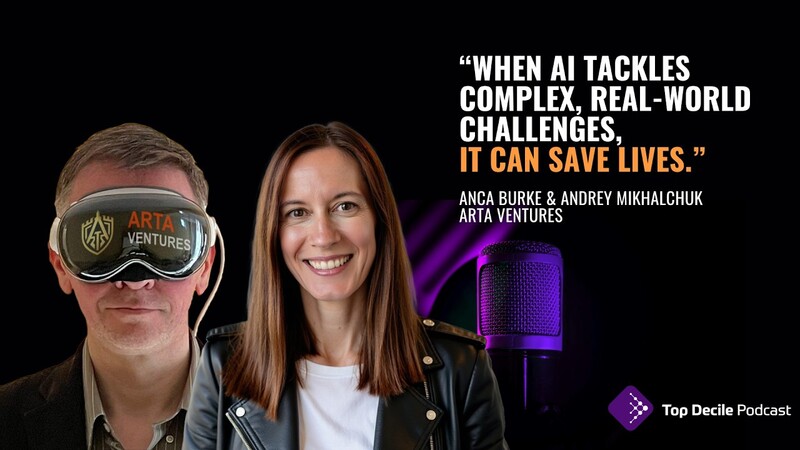
The traditional VC used to come from finance. Anca Burke and Andrey Mikhalchuk came from everywhere else: venture and corporate VC, healthcare, enterprise software, government, the National Security Innovation Network, and decades of building companies. Now they run ARTA Ventures together, backing US Applied AI founders at the seed stage where the workflow and the revenue are already real. On the Top Decile Podcast, they made the case for a kind of fund where, as host Connor Sattely put it, "the operators are the investors and the investors are the operators."
Watch The Full Episode Here:
From a Theranos No-Go to a Fund of Her Own
Anca's read on founders was sharpened early, and expensively for anyone who ignored it. "I met Elizabeth Holmes from Theranos and I was one of the analysts behind the review of their proposal and pitch to at the time the Blue Venture Fund," she said. She "was the one who supported a no-go investment in Theranos." From there she started a real estate fund of her own, moved into operating roles across several startups, and eventually joined the National Security Innovation Network, "where I saw an opportunity for a lot of deep tech startups that were getting missed or underfunded." That combination of capital-side judgment and hands-on commercialization is what she brings to ARTA.
The Super Connector Who Said "You're Crazy, Bye"
Andrey's path to VC ran through resistance. Friends kept telling him to start a fund, and his answer stayed the same: "I said, you're crazy, bye." He is a computer scientist by training. "I was building my neural networks back when it was not cool yet in 90s," he said. The local ecosystem noticed his other talent too. He was "named the super connector of the DMV by our largest tech community," DC Tech.
What finally changed his mind was a frustration, not an opportunity. He described "this whole feeling of the modern VC system of being a little bit broken," especially at the earliest stages. "I don't want to be part of this broken system," he said. "But then we got a chance to do something to fix it and do it right." The research that led him there pointed to one place: "I found this awesome organization. It's called VC Lab." He and Anca teamed up for a cohort, trained for several months, and, as he put it, "we actually graduated. And we're really grateful to Decile Group and to VC Lab for this education."
Why Applied AI, and Why Now
ARTA is not chasing AI in the abstract. Anca's first brush with the technology was a computer vision system that watched drivers and the road at once to warn of a possible accident. "AI, that's saving lives," she said. That instinct shows up in the portfolio. Their first investment, she explained, is a company that uses "artificial intelligence in eyeglasses to help correct eye vision problems," primarily in people over 55. The team "built a multi-lens, proprietary multi-lens system that autofocuses in real time based on where you look."
Andrey frames the thesis around a failure rate. "70 percent of all efforts to integrate AI into existing enterprises, they fail," he said, because even executives struggle to attach the new thing to what they have built for decades. "They want AI, they want it now, they have no idea how to use it. So we are actually investing in companies that build around AI, that already found a purpose for AI and then they build their business around that purpose." ARTA writes $100K to $250K first checks into applied AI across software, hardware, robotics, space, and dual-use. When asked to call his shot, Andrey did not hedge: "robotics would be the next revolution," and paired with space exploration, "I would say double down on them, triple down on that." Anca agreed. "It seems that Andre and I are thinking the exact same thing."
Moving Capital in the DMV
There is a regional mission underneath the fund. "The DMV is the second largest talent pool in the country," Andrey said, "second only to Silicon Valley," home to five of the ten richest counties in the United States. Yet "all this money is not flowing towards great ideas." ARTA is trying to "hack the situation and make money to flow instead of real estate to actually fuel some great ideas," partly through an angel group that gathers investors and founders in one room with working demos on the table.
For LPs and Founders
The LP pitch, Anca said, is unusually easy because the product does the talking. "Once we are face to face with someone who resonates with startups and the types of industries we're looking at, actually the conversation is really easy." Andrey adds hard numbers to the timing. He points to Q1 2026 as the biggest VC quarter ever, with roughly "300 billion invested" and around 75 percent going to companies using AI, even as investment at the seed and pre-seed level has declined about 30 percent year over year. "We are on the hottest market right now, where the offer is huge and the supply is very small." For the LPs he wants, the appeal is more than returns. Instead of bragging about buying another Bitcoin, he said, being able to say "I actually did something to bring this great idea to life and to actually help people, I think that's very honorable."
Learn more about the fund and request access on Decile Access: https://decileaccess.com/funds/arta-ventures
About ARTA Ventures
ARTA Ventures backs US Applied AI founders at the seed stage across software, hardware, robotics, space, and dual-use, writing $100K to $250K first checks where workflow and revenue are real. Co-founders Anca Burke and Andrey Mikhalchuk are VC Lab graduates and lifelong operators, and the fund is anchored in the DMV region with the goal of moving concentrated regional capital toward the applied AI founders it too often skips.
Watch The Full Episode Here: https://www.youtube.com/watch?v=dQrrHNrfX-k