
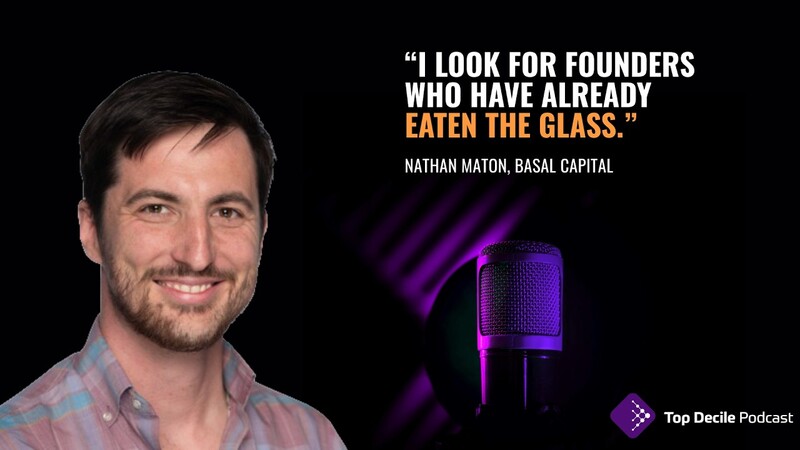
Most investors say they bet on founders. Nathan Maton built an entire fund around one specific kind. On the Top Decile Podcast, the Basal Capital founder told Decile Group's Connor Sattely why he backs repeat founders, how a chance conversation in Las Vegas turned an angel habit into a fund, and why the second company almost never announces itself with a deck.
Watch The Full Episode Here:
Nathan is a three-time founder who spent his career at the intersection of design, technology, and human behavior, with stints at Google, Khan Academy, and Omada before he turned to investing. He also runs The Clearing, a workshop for founders navigating life after a significant exit. That work led to his thesis: the second-time founder may be systematically underserved at the earliest stage.
Why Repeat Founders
Connor pushed back immediately. Isn't backing experienced founders obvious? Nathan's answer is that "repeat founder" is shorthand for a cluster of traits he watched pay off in his own angel checks. The founders who did really well were, in his words, "extraordinarily persistent," mature, and able to handle the co-founder conflict that quietly kills companies.
The trait he keeps returning to is persistence, forged by what he calls "the eating glass part of entrepreneurship." As he put it, "I've done three companies," and at some point every one of them got harder than expected. Repeat founders who sign up a second time have usually already proven they can take that. But he's careful not to make it a rule. A first-time founder with that persistence gets his attention. And "if you're a Repeat Founder without that extraordinary persistence, I'm less excited." The label is a shortcut, not a filter. What he's really hunting for is the glass eater.
From an Angel Habit to a Fund
Basal started with a conversation. Nathan was in Las Vegas at Inception Studio, a program for repeat founders, actually weighing whether to start a fourth company, when he ran into an old friend running a small fund. "It just opens my mind," he said. He realized he didn't have to chase a massive institution to do this. "I'm not really a thriver in a huge system. I'm a thriver in an elite small system."
He applied to Decile shortly after. What stuck with him was the honesty. He remembers Adeo Ressi telling the cohort that right now they had a dream, and their job in the coming weeks was to see if there was any merit to it. "It lit a fire under my ass." Nathan responded the way a good operator does. He ran roughly 15 LP meetings a week that first month and posted his numbers in Slack every single day.
An LP Base That Is a Moat
Nathan doesn't want passive capital. He wants LPs who hand him a structural edge. As he framed it, he's looking for "someone who gives me a structural advantage for the founders and for the assessing of the deal." In FinTech he wants FinTech executives and exited founders. In AI, the same. He points to one LP who was early at YouTube doing marketing as the perfect profile: someone who "can coach, can teach, can assess." He isn't trying to lead. He's trying to be "the top value-add partner to the impressive people in the world in the spaces I know something about." That is how a small fund earns a slot in a red-hot round.
The Second Company Starts in Private
Nathan's edge shows up in how he gets into deals. Take Hyperspell, an AI company he invested in. He'd met the founder years earlier in a hundred-person program, spent a week with him, and watched him and his co-founder collect awards. "I gotta get involved with these guys," he decided, and angel invested. When the company went through YC a year and a half later and oversubscribed its round, that early relationship is what let him back in.
That is the thesis in practice. By the time a proven founder writes a deck for company number two, the round is often already gone. The conviction comes first, from time spent, not from a pitch. As Nathan described a different founder he's tracking: "please just let me take my money. I know whatever you're gonna do, you're gonna succeed."
The Markets He's Watching
Two markets have his attention. As a two-time blockchain founder, he's focused on stablecoin infrastructure, which he calls "the third inning of digital money." He points to volume where "we're seeing more volume on stable coins than we see on like Visa and MasterCard combined," and expects it to keep climbing.
The second is AI, and he doesn't hedge. "I think it's very possible AI is going to be bigger than the internet, not incrementally bigger, but like categorically bigger." He frames this moment as a rare window to be investing, when even the smartest people admit they don't know what's coming next.
For LPs and Founders
For LPs, Basal is a curated way into repeat founders in FinTech and AI with a manager who is close enough to the deals to get in early and honest enough to know his own edge. For founders, Nathan's advice is the same thing that drives his own fund. Find work that is authentic to you, learn to hold advice and conviction at the same time, and start now. "Don't ask for permission."
Learn more about the fund and request access on Decile Access: https://decileaccess.com/funds/Basal-Capital
About Basal Capital
Basal Capital is a US-based pre-seed and seed fund backing repeat founders in FinTech and AI. Founded by three-time founder Nathan Maton, whose 12 angel checks into repeat founders since 2021 have returned 5.35x at a 47% annualized rate, the fund is built on the conviction that the most resilient repeat founders, the glass eaters, are underserved at the earliest stage, and that the way to back them is to earn conviction and access before the round is even announced.
Watch The Full Episode Here: https://www.youtube.com/watch?v=WL7dwQg3D9s