
Most VC funds underperform public markets.
The ones that don't, the top decile, are often the funds nobody has heard of yet.
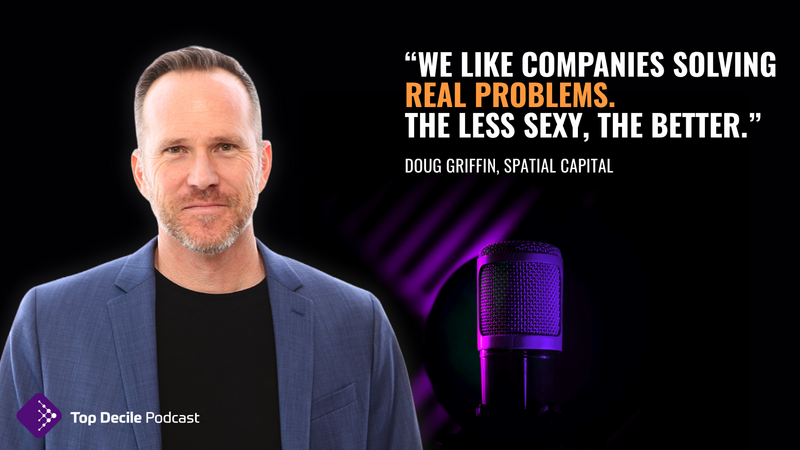
That is the premise behind The Top Decile Podcast, where Decile Group's Connor Sattely goes one-on-one with the emerging managers quietly building those funds. The first guest of Season 1 is Doug Griffin, founder and managing partner of Spatial Capital, an early-stage fund focused on physical AI and spatial computing.
Doug is one of the rare VCs who has been the kind of founder he now funds. Four computer vision and AI companies. Three exits, including acquisitions by Apple and Roblox. Thirty years of operating experience across nearly every seat in the building. Engineer. Engineering manager. VP of product. VP of corporate development. Chief marketing officer. President. Founder. He has done every aspect of building a tech company except work in finance.
Then he switched sides of the table.
Why Physical AI Is the Next Decade of Venture
Doug saw this coming before most of the world had heard of ChatGPT.
"This goes back to pre-GPT," he said. "Before the launch of ChatGPT, we were talking about and seeing how AI was going to affect computer vision in particular. In fact, it's the reason I decided to start the fund."
Spatial Capital launched three years ago around what Doug calls the perception layer. AI taken out of the chat window and pushed into the real world. Systems that understand and interpret what they see in three dimensions.
About 18 months later, the next layer started showing up. Not just perceiving the world, but embedding intelligence into it. In January 2024, Jensen Huang at Nvidia gave it a name: physical AI.
"That term really made sense," Doug said. "It was the term we'd been looking for for a long time."
The two areas everyone is talking about now in physical AI are autonomy and robotics. Both are about understanding the physical world, making decisions in real time, and navigating it.
But Doug believes that's just the opening chapter.
"This is just the tip of the iceberg. It's just the very start of what we're going to see over the next decade."
The Operator's Edge
Spatial Capital is not a billion-dollar fund. It is not trying to be one.
What Doug brings to the table is something most billion-dollar funds cannot replicate: thirty years of pattern recognition inside a single industry, lived from every angle of company-building.
He has raised money. Exited companies. Bought companies. Sat in product, marketing, engineering, executive, and founder seats. All inside computer vision and AI.
That kind of depth shows up in how he runs the fund.
"When pitching to a VC, they'd often pitch back and tell me how I should run my company," Doug said about his founder days. "Then I'd look at their LinkedIn afterwards and realize they came straight from Yale or Harvard into a VC firm and never had any operating experience."
That experience now shapes Spatial Capital's edge.
"I have a significant amount of operating experience in VC-backed startups, in the space of computer vision and AI that I've been involved in for multiple decades. I think that puts me in a unique position to lead a fund like this."
It is also how he finds deals nobody else can. Doug recently invested in a startup in Sweden after his network surfaced a thesis-fit company on the other side of the planet.
"That wouldn't have happened at a larger firm. It's our knowledge, our network. Everyone at Spatial Capital has well over a decade, usually 25 years, in this space. The kind of spider web of networks we've created allows us to make inroads into companies that I think larger funds might not be able to track down."
Founders feel it too.
"When these small companies look at us and see that we've actually lived in their shoes, see where we've worked and what we've done, it opens up a lot of doors. They're so welcome to have Spatial on their cap table."
Turning LPs Into Active Operators
Most VC funds keep LPs at arm's length.
Doug does the opposite.
The vast majority of LPs in Spatial Capital are what he calls working blokes. VPs. C-level operators. Computer scientists. Computer vision researchers. People embedded in the same industry his portfolio companies are trying to win.
Every time Spatial makes an investment, Doug schedules a 30-minute call between the new portfolio founder and his LPs.
"There's nothing better than that personal interaction. The founder pitches our VCs directly. Here's what we're doing and why. Here's my background. Here's the problems we're having. Here's where we need help. Numerous conversations come out of the back side of that. A handful of different LPs end up supporting and providing strategy assistance to our portfolio."
In some cases, those LPs end up inside the portfolio companies as full-time hires. Even at the C-level.
"It's been very beneficial."
This is what specialist, operator-led venture capital looks like in practice. The cap table becomes a working network instead of a closed list.
Why 4Point AI Could Be a Goldmine
When asked which Spatial portfolio company keeps him up at night for the right reasons, Doug pointed to a recent investment.
4Point AI tackles mineral discovery. Today, digging a new mine takes an average of 13 years. Mining companies spend tens of millions of dollars drilling around 1,000 pilot holes hoping to find one site with promise.
4Point compresses that 13-year process into roughly 3 years using AI models that combine soil analysis, satellite footage, and drone footage. They also save tens of millions of dollars per discovery.
Then they do something most software companies don't.
"Rather than just selling that as a SaaS business, they actually take a percentage of profits made off of those discoveries. So they're literally sitting on a goldmine."
It hits all of Doug's investment markers. A massive industry. An ugly, non-digitized one. Real-world problem with measurable economic impact. AI applied at the perception layer to a physical asset.
"They are ones to watch out for in the coming months to years."
Why He Built His Fund With Decile
Doug had been on every side of the building of a company. He had not been on this side of a fund.
"I've worked at public companies as an executive in this space. I've worked at startups from day one, raising $20 million, working with VCs. I'd never sat on the other side of the table though. I've never sat in a position where I was investing in companies."
There were a lot of landmines. Policies. Legal structures. Operational requirements. The kind of things that quietly derail emerging managers before they ever close their first fund.
"Honestly, the things I don't want to do and the things I am not good at are the value Decile provides. They take care of all the things that are a little uncertain to me. It frees me to focus on the things that add the most value to my LPs and my portfolio."
Doug is now raising Fund II with Decile.
"This is the second fund we've done with them. And honestly, I wouldn't have done a fund without Decile."
Advice for Emerging Managers
When asked what he wishes he could tell new managers a few dozen LP meetings into their fundraise, Doug's answer was clear.
"You have to have a lot of domain expertise and network into the areas in which you're investing. If you don't, it's going to be a really hard journey."
Find your edge before you raise.
"Why should someone give you money to go out and invest? Do you have amazing deal flow? Do you have unique knowledge? Whatever that may be, you need to really find that and understand it before you even think about raising a fund."
Doug's edge took 30 years to build.
His fund will deploy that edge for the next 10.
That is what specialist venture capital looks like in 2026.
Watch the full episode on YouTube, Spotify, and Apple Music.
You can learn more about Doug's fund, Spatial Capital, on Decile Access: https://decileaccess.com/funds/spatial-follow-fund-i
Join VC Lab
VC Lab, the leading venture capital accelerator, empowers new and emerging managers worldwide to close ethical, high-performing funds in under six months. The program provides cutting-edge tools, expert mentorship, and a global network to raise more money in less time. Apply if you want to build a meaningful venture capital firm.